
Our Philosophy
We believe true indulgence does not come from taste alone, but from quality, the right choice of ingredients, and integrity in every process. Each product is made from selected Grade AA surimi, a single species Itoyori golden threadfin bream to achieve a very clean, premium protein base.
All products are processed under global HACCP and Halal standards, using modern subzero temperature surimi extraction and forming technology to deliver a tender texture, clean flavor, and a gentle seafood aroma without any fishiness.
We handle every step with responsibility, from sourcing seafood with care for sustainability to maintaining a strict cold chain all the way to your kitchen, so every seafood dish remains naturally fresh, safe, and dependable. Our philosophy is simple: quality seafood, trusted process, and a result that truly Taste Amazing!
Seafoodking is more than a brand. We aim to be your partner in serving premium, consistent seafood for home kitchens as well as professional hotels, restaurants, and cafés.

About Us
Seafoodking was created to answer the growing demand for high quality processed seafood for families and professional kitchens across Indonesia. Rooted in a surimi tradition that has developed globally since the 1970s, we bring international standards of seafood quality into Indonesian homes and professional kitchens, with a focus on single species Itoyori based Grade AA surimi as the base for all our product range.
Our product portfolio includes fish protein balls, surikama (shaped products), crab sticks, fritters, dim sum, and other ready to enjoy high quality seafood items. All are made from selected deep sea fish under strict control of hygiene and food safety.
Our commitment goes beyond products. We work to be a reliable partner for HORECA operators and modern trade retailers by offering items that are practical, versatile, and easy to apply across many menu types, from home cooking and hot pot to quick serve concepts, cafés, and restaurant style dishes.
With Seafoodking, you are not only buying frozen seafood. You are choosing convenience, trust, and premium seafood taste, every day.

What is Surimi?
It is a frozen fish paste made from boneless, skinless fish meat that has been washed and finely ground, then frozen and mixed with ingredients such as sugar and salt for preservation. This product is commonly used as a semi-processed ingredient to make a variety of processed foods, including imitation seafood such as crab, shrimp, and fish sausages.
Why Surimi is Better than Regular Fish
Shelf Life
Surimi is frozen, allowing it to have a longer shelf life.
Texture & Flavor
It has an elastic, springy texture due to its high myofibrillar protein content. Its neutral flavor also makes it easy to combine with a wide variety of seasonings and other ingredients.
Healthy & Nutritious
Surimi is rich in vitamins and minerals, is a good source of protein, and is low in fat and calories, making it beneficial for the body.
Easy to Prepare
The surimi production process allows fish meat to be processed into a wide range of value-added products, such as fish sticks or imitation seafood, in various shapes and sizes.
Differences in Processing
Regular Fish | Surimi |
|---|---|
It consists of whole fish meat or fillets that have not been extensively processed from the initial stage into processed products.
Fish meat that has been finely ground, washed repeatedly in cold salt water to remove fat and blood, then combined with other ingredients, frozen, and packaged.
Surimi Content

Protein
Krioprotektan
Mineral
Low Fat
High Vitamin
Surimi Production
Equipment

Meat Bone Separator

Silent Cutter

Leaching Tank

Continues Screw Press

Strainer
Ingredients

Fish Raw Materials

Seasoning

Water & Ice

Surimi Packaging
Surimi Making Process

1. Fish Selection
Fishermen will select fish from the sea for surimi production.
The fish used to make surimi vary.
However, for Seafoodking products, the type of fish used is threadfin bream.
2. Weeding the Fish
Fish cleaning is the process of preparing fish by removing the scales and internal organs.
This process aims to eliminate impurities, most of which are sources of microbes found on the fish’s body.
The method of cleaning fish also greatly depends on the size of the fish.

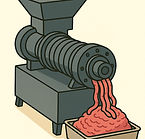
4. Separating Bones & Meat
Meat separation can be carried out either manually or using a Meat Bone Separator machine.
For the manual method, the process is done by filleting the fish with a very sharp knife or scraping the fish meat using a spoon.
Make sure the fish is completely clean of scales and fully separated from the bones.
3. Washing the Fish
Washing is the process of removing impurities attached to the fish’s body, such as blood and other residues.
The fish are washed using clean, cold water (ice water). It is recommended to wash the fish under running water.
After washing, the fish are placed in containers with ice continuously added to maintain a low temperature.
png.png)

5. Grinding the Fish
The fish meat grinding process aims to break down muscle fibers in order to enhance the extraction of salt-soluble proteins.
The equipment used includes a grinder or a food processor.
During the grinding process, both the fish meat and the machine must be kept cold, so ice should be added periodically.
However, if the meat separation process has already used a Meat Bone Separator, grinding is not necessary, as the fish meat is already in a minced form.
6. Leaching
Leaching is the process of washing or soaking fish meat in ice water to remove blood, pigments, fat, mucus, and water-soluble proteins.
In addition, this process helps improve the color and odor of the fish meat.
Leaching is carried out by mixing minced fish meat with ice water at a temperature of 5–10°C, then agitating it mechanically or stirring it manually.
This process is repeated three times.


8. Adding Additional Ingredients
The minced fish meat produced is then mixed with approximately 3–4% sugar/sucrose or sorbitol, and 0.2–0.3% polyphosphate.
Sugar functions as a cryoprotectant, while polyphosphate acts as a water-binding agent to maintain water-holding capacity.
This mixing process can be carried out using a grinder, mixer, food processor, or silent cutter.
7. Pressing
Pressing is carried out to remove excess water so that the final product has a moisture content of 80–85%. The meat used at this stage is fine, smooth-textured fish meat.
The process uses a continuous screw press. In this equipment, the fish meat is pressed by being rotated or pushed forward through a perforated screw-like screen.


9. Freezing the Surimi
The final stage of the surimi production process is freezing and shaping the surimi itself. The shaping process can be carried out using rectangular pans or trays sized to match the primary packaging plastic.
Afterward, the surimi blocks are frozen in a contact plate freezer or an air blast freezer.
10. Surimi Ready for Distribution
After going through all the processing stages, the surimi is ready for distribution.

